Cattle
Voices from ChernobylCattle in Voices from Chernobyl occupy a difficult boundary between domestic life and environmental disaster: they feed the people who refuse to leave them, carry contamination into food systems, and become objects of both official control and private grief. The accounts follow cows and other livestock from family yards and village farms into evacuation, testing, slaughter, and burial, showing how the Chernobyl disaster made ordinary care inseparable from danger.
Livelihood, Home, and Attachment
For rural households, a cow is not an interchangeable possession. One woman recalls having two cows and two calves among the animals that filled her yard, alongside pigs, geese, chickens, and a dog. Her inventory also includes abundant apple trees and the work of maintaining a lived-in home; when evacuation came, the loss was not simply property left behind but a whole arrangement of labor, food, and daily familiarity. The cow stands within that domestic world as both a dependent animal and a provider.
That dependence shapes a later encounter with medical advice. A woman with painful legs and joints is told to give up her cow because its milk is poisoned. She refuses: despite her pain, the cow feeds her. Her decision is not presented as ignorance erased by a simple warning. It registers the practical cost of abandoning a central source of sustenance, especially when the alternatives are uncertain or inaccessible. The contaminated milk makes care hazardous, but the animal remains indispensable.
The emotional bond also persists after forced departure. An older woman asks whether she may drink milk from her cow; when told to drink as much as she likes, she receives reassurance rather than a reliable account of the risk. The exchange captures how people look to educated visitors for guidance while those visitors are constrained by orders to collect information and avoid speaking with residents. Cattle are therefore not only a matter of food safety: questions about them become tests of trust, responsibility, and what people are permitted to know.
Contamination in the Food Chain
The book gives contamination a domestic scale through changes in familiar food. One account describes chickens with black rather than red combs and milk that would not sour or become cheese and cottage cheese; instead, it curdled into a white powder. The explanation offered is radiation. Such details make invisible contamination legible through disrupted routines, even as they leave villagers to interpret unfamiliar effects with limited information.
Investigators testing products from the thirty-kilometer zone reach a more direct conclusion. By the end of May, their institute is working around the clock, receiving animal organs and checking milk. They find that what is being handled cannot properly be called meat or milk, but radioactive byproducts. Herds remain within the zone under a shift system: shepherds come and go, while milkmaids are brought in only to milk the cows. Meanwhile, milk factories continue to meet the government plan. Production carries on even as the products fail the most basic expectation of being food.
The contamination does not stop at the farm gate. In village stores, food lies beside clothing without protective wrapping. Investigators test salami and eggs and conclude that these, too, are radioactive byproducts. Breast milk is also found to contain cesium; the image of a mother nursing near her home is named the Chernobyl Madonna. Cattle and their milk thus belong to a larger chain of exposure in which animal products, household stores, and human bodies are connected, while the language of ordinary consumption no longer guarantees safety.
Official reassurance sharpens the contradiction. Television shows a woman milking her cow and a military dosimeter apparently demonstrating that the milk is safe, even though the reactor is nearby. The narrator identifies the demonstration as false: the military instruments being used were designed to measure background radiation, not individual food products. The cow’s presence in the broadcast supplies a reassuring domestic scene, while the method of measurement cannot establish what the scene claims. A familiar act of milking becomes part of a public performance that conceals rather than resolves the danger.
Evacuation, Orders, and Unequal Control
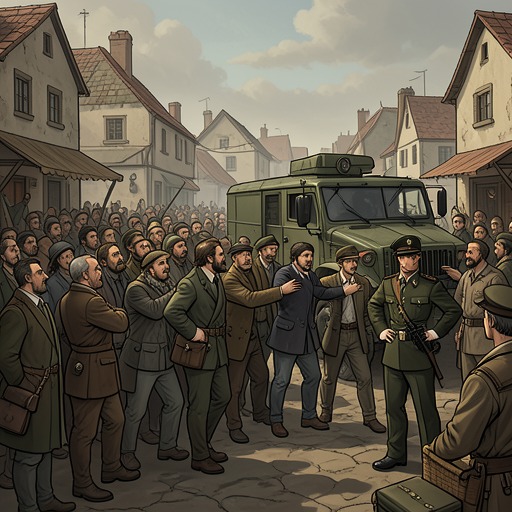
The treatment of cattle reveals the uneven logic of evacuation. Soldiers establish roadblocks and observation posts to keep former residents out of evacuated villages. Farmers are prevented from retrieving ordinary belongings or harvesting crops, yet on the other side of the road cows graze, harvesters work, and grain is shipped. The contradiction is visible to the people enforcing the boundary: access to land is prohibited to its former inhabitants even while agricultural activity continues nearby.
The handling of milk and produce turns that contradiction into a daily duty. A soldier stands beside a woman as she milks her cow, then ensures she pours the milk onto the ground. Another watches an old woman bury eggs; potatoes raised and harvested by farmers must also be buried. The surrounding land is described as beautiful, which makes the required destruction harder to reconcile with what can be seen. The animals remain physically present, but their products and the people’s labor are declared unusable. Contamination does not merely threaten a harvest; it reverses the meaning of work that has sustained village life.
Livestock from evacuated villages are also gathered at designated points in a regional center. Cows, calves, and pigs run through the streets, and people can catch them. Canned meat made from the animals is sent toward Moscow, but the cargo is rejected. Train cars return, described as graveyards, and are buried locally; the narrator remembers the smell of rotten meat at night and connects it to the remembered smell of war. In this sequence, the livestock move from displacement to processing and then to disposal, while the failed shipment leaves the consequences with the affected region.
Another account states that cattle were transported from Belarus to Russia and sold, although the heifers were leukemic and offered at a discount. The transaction places economic exchange alongside known disease rather than ending it. The animals and their products move through systems of transport and sale, while the risk is absorbed by buyers and communities distant from the original contaminated area. The record does not make every fate identical: it shows both livestock buried after rejection and animals entering markets despite illness.
Wild Animals and the Limits of Human Management
Cattle appear in accounts of a landscape that cannot be controlled by evacuation boundaries. One speaker hears cuckoos and magpies and sees roe deer running, then wonders whether they will reproduce. Wild boars dig in a garden. People can be resettled, the speaker observes, but elk and boar cannot be moved in the same way; water, too, crosses borders above and below ground. Domestic cattle are part of this ecological predicament: they can be penned, milked, transported, or shot, but their exposure belongs to a contaminated environment that extends beyond administrative lines.
A hunter describes a cow walking with her calf and says that they do not shoot them. Horses are spared as well: though afraid of wolves, they can defend themselves, whereas wolves take cows first. The observation places cattle within a changed relationship among animals after people have withdrawn or lost control. The phrase that this is the law of the jungle describes predation without turning it into a moral judgment. The animals are not simply disappearing from a human story; their vulnerability and capacities help show how life reorganizes when ordinary protection and husbandry break down.
Elsewhere, a soldier describes closed houses and a cow pressing its head against a gate, its milk dripping onto the ground. The image joins animal behavior to the destruction of human labor: the cow remains at the threshold of a home and farm, but the gate is shut and the milk has no household use. In the same account, farmers struggle to accept the order to destroy or bury what they have grown. Their seeds and green tomatoes, like the cow at the gate, embody a continuity of work that the disaster has made untenable.
Narrative Significance
Across these testimonies, cattle make the invisible crisis concrete without making it simple. Milk changes, animals are tested, products are buried, and television presents milking as proof of safety. Yet the same animal can be an essential source of food, a suspected carrier of contamination, a patient in an agricultural system, and a companion to people who cannot bear to leave their homes. The accounts refuse a clean division between nature and human society: village survival depends on animals, while radiation travels through the relationships that make that survival possible.
The cattle’s fates also expose the distance between formal orders and lived necessity. A doctor’s instruction to give up a cow cannot by itself replace the food it supplies; a soldier’s command to pour out milk cannot restore the labor already spent producing it; and a shipment rejected by Moscow leaves its burden where it began. At the same time, the narrative does not treat attachment as proof that food is safe. It holds both truths together: a cow can be beloved and necessary, and its milk can be dangerous. In that unresolved tension, cattle become one of the book’s clearest measures of what the disaster changed in ordinary life.